


How to Get Permanent Residency in Japan: The Total Guide

Permanent residency in Japan (eijuken, 永住権) grants foreign nationals the right to live and work in Japan indefinitely, in any legal occupation, without the restrictions of a standard work visa.
The standard requirement is 10 consecutive years of residence, with at least 5 of those years on a work visa or family-based status such as Spouse of Japanese National.
However, the Highly Skilled Professional (HSP) points system can reduce this to 3 years (70 points) or 1 year (80 points), and the J-Skip visa offers a 1-year fast track for top earners.
As of 2026, Japan's Immigration Services Agency (ISA) has tightened screening considerably: applicants must now hold a 5-year visa (with a transitional grace period until March 31, 2027 for 3-year holders), demonstrate an annual income of at least 3 million yen, and show a perfect record of on-time tax and social insurance payments.
This guide covers every step of how to get permanent residency in Japan: eligibility requirements, special provisions that shorten the residency period, the full document checklist, a step-by-step application walkthrough, and common missteps that lead to refusal.
Bookmark this page for easy reference to eligibility requirements, what special provisions might apply to you, all the documents you will need to prepare, a step-by-step guide to keep you on track, and a list of common missteps to avoid!
👉 Note: This article cannot serve as a substitute for tailored legal guidance. We suggest you ask an immigration lawyer to help you with research for specific questions on how to get pr in Japan.
What are the basic eligibility requirements for permanent residency in Japan?
The following are the basic eligibility guidelines for a permanent visa requirements in Japan (永住権 = eijuken), summarized from the Ministry of Justice's (MOJ) official statement, all of which must apply to you:
You have shown good behavior. You lead a law-abiding life in Japan.
You have a stable income. You earn enough (or your spouse earns enough) to live independently in Japan. In practice, the immigration authorities apply a benchmark of approximately 3 million yen per year in annual income for a single applicant. An additional 700,000 to 800,000 yen per year is expected for each dependent. Income stability over the past 3 to 5 years is assessed, not just the most recent year.
You have a guarantor. Your guarantor must be a Japanese national or holder of a permanent residency visa.
Your presence is good for the interests of Japan.
2026 update: New visa duration requirement. As of February 24, 2026, the ISA revised its PR guidelines to require that applicants hold the maximum period of stay for their visa category, which is 5 years for most work and family visas. Previously, holding a 3-year visa was accepted in practice. A transitional provision allows applicants currently on a 3-year visa to submit one PR application before March 31, 2027. From April 1, 2027, only 5-year visa holders will be able to apply for permanent residency.
Additionally, the following clauses are stipulated in MOJ's guidelines:
You have stayed in Japan for at least 10 consecutive years, 5 of which were under a work visa or other family status visa;
You have not been fined or imprisoned. You have also fulfilled all public obligations, such as payments of tax, pension, and health insurance premiums;
Your stay will not cause harm to public health in Japan.
Special provisions to the 10-year residency clause
The simplest method to get PR in Japan is to complete a 10-year residency, where you do not leave Japan for more than a year at any one time.
However, there are cases where the 10-year residency clause can be shortened. If any one of the following applies to you, you may be eligible to apply for a PR visa:
You are a spouse of a Japanese citizen or a spouse of a permanent resident, married for more than 3 years, and lived in Japan for more than 1 year consecutively.
You are the child of a Japanese national or permanent resident and have stayed in Japan for more than 1 year consecutively.
You have stayed in Japan for more than 5 years consecutively with the status of a long-term resident.
You have been recognized as a refugee, and you have stayed in Japan for more than 5 years consecutively after recognition.
You have been recognized to have contributed to Japan in diplomatic, social, economic, cultural or other fields, and you have stayed in Japan for more than 5 years.
Points-based preferential eligibility clause
Aside from the clauses mentioned up to this point, there are other clauses that will allow you to apply for a PR visa in Japan. Here are the Japan PR requirements based on the point system:
You have stayed in Japan for 3 straight years and have scored 70 points for a full 3 years + the year leading to your PR application.
You have stayed in Japan for more than 1 continuous year and have a total of 80 points for an entire year + the year leading to your PR application.
Additionally, the J-Skip (Special Highly Skilled Professional) visa, introduced in April 2023, offers a separate fast track.
J-Skip holders can apply for permanent residency after just 1 year of continuous residence in Japan. J-Skip eligibility requires a master's degree or 10 or more years of professional experience, combined with an annual income of at least 20 million yen (or 40 million yen for business management roles). Unlike the standard HSP points system, J-Skip bypasses point calculations entirely.
The points mentioned here correlate to the points system developed for evaluating the immigration status of Highly Skilled Foreign Professionals.
For easy calculation, use this Japan PR calculator.

Image: The Points Calculation Table from MOJ
Additionally, for those interested, here is the English-language Point Calculation excel form, hosted on the MOJ site.
What documents are needed for permanent residency in Japan?
The following list is translated and summarized from the MOJ site and outlines what to prepare and the documents needed for permanent residency in Japan. Also note, that some of the required documents will depend on your current visa/employment status.
Here are the documents to prepare for your PR application:
Permanent resident permit application 永住許可申請書 = eijuken shinseisho
Photograph 4x3 (taken within the last 3 months)
A reason letter for permanent residency Japan (free form, but must be submitted in Japanese) 理由書 = riyuusho
Certificate of employment (if you are working for a company) 在職証明書 = zaishoku shomeisho
Tax return (if self-employed) 確定申告書の控え= kakutei shinkokusho no hikae
Business permit (if self-employed and applicable) 営業許可書 = eigyo kyokasho
Tax payment proof (for years lived in Japan or for years under the point-based system) 納税証明書 = nozei shomeisho / 課税証明書 = kazei shomeisho
Proof of income/assets (photocopy of bank book, etc.) 預貯金通帳の写し= yochokintsuchou no utsushi
National pension payment proof 各月の年金記録 / 国民年金保険料領収証書 = nenkinteikibin /kokuminnenkin hokenryou ryoushuushousho
Health insurance premium payment proof 健康保険・厚生年金保険料領収証書 = kenkouhoken/kouseinenkinhokenryou ryoushuushousho
Passport ID page photocopy
Residence card photocopy, front and back 在留カード= card
Guarantor's letter (English form; Japanese form) 身元保証書 = mimoto hoshousho
Documents certifying guarantor's nationality, residence, income, and occupation
Additionally, if you are applying with the point-based system, you will need to prepare the following:
Your points calculated based on the previously mentioned Point Calculation Table
Evidence to support your point calculation score (photocopy of degrees, JLPT certificate, etc.)
Some other Japan permanent residency application documents includes a photocopy of your national health insurance card, letters of recommendation from upstanding citizens, and other additional material documenting your contributions to Japan and proof of good character as recommended by other immigration experts.
Step-by-step guide on how to apply for permanent residency in Japan
Break down an arduous task—one step at a time. Use this step-by-step roadmap to help you plan and prepare for how to apply for a permanent visa in Japan.
Step 1. Assess if you are eligible.
Examine the eligibility guidelines and determine if you meet the criteria for permanent residency. There is enough documentation on the topic in English to complete this first step on your own.
Step 2. Find a guarantor.
Your guarantor must be willing to sign and submit a Letter of Guarantee. There are no legal responsibilities that the guarantor must carry in relation to your application. Their purpose is to attest for your good character.
All that is required of guarantors is that they are willing to sign the Letter of Guarantee and provide the following documents: a certificate of residence, tax certificate, and employment certificate.
The guarantor must be a Japanese national or another individual who has PR in Japan. For those married to a Japanese national, their spouse can be their guarantor. If that is not the case for you, asking colleagues, bosses, or even Japanese friends would suffice.
Step 3. Consult a lawyer or book a consultation with an immigration bureau.
For cases where you have a spouse, dependents, or other questions that may or may not affect your eligibility, consult a lawyer or a legal office specializing in visas. They can explain on how to get permanent residency in Japan for your specific case.
Alternatively, the Tokyo Regional Immigration Services Bureau offers free consultations at the Foreign Residents Support Center (FRESC) in Shinjuku, Tokyo.
Step 4. Enroll and pay National Pension premiums.
If you aren't already enrolled in Japan's National Pension System, you must apply and then show proof of having paid premiums for the last 24 months.
To acquire proof of payment, register to the nenkin.go.jp site and (after having paid your premiums) print out the “Monthly Pension Record” (各月の年金記録 = kakutuki no nenkin kiroku).
Step 5. Write a “reason” letter.
There is no set form for this letter, but it must include why you desire a permanent resident visa.
You may also want to include a brief background, history of stay, career highlights in Japan, and your family structure. You can write it in English, but submit a Japanese translation, too.
Step 6. Prepare documentation.
Gather all needed documentation, print out the Japan PR application form, and get any English-language documentation translated to Japanese.
Step 7. Do a final check.
Give the MOJ guidelines a final check, ensuring that all your documents are in order. Remember, one mistake on a form or forgetting a requested document can equal numerous delays.
Step 8. File your application.
Bring all documentation to the Immigration Bureau for your city (there are 12 branches in Tokyo). Wait times are notoriously long, and these offices are only open on weekdays from 9 AM to 4 PM, so plan ahead.
After submitting your documents, you will be asked to write your address and name on a postcard, which they will send to you when your application results are ready.
Step 9. Wait and wait some more.
Processing times for permanent residency applications have increased significantly in recent years.
As of 2026, applicants in the Tokyo region should expect a wait of 12 to 18 months.
Outside Tokyo, processing times typically range from 6 to 12 months.
Plan your timeline accordingly, especially if your current visa expires during the wait. Your existing visa status remains valid while your PR application is pending, but you must renew it if it expires before a decision is reached.
Step 10. Pick up your permanent residence card.
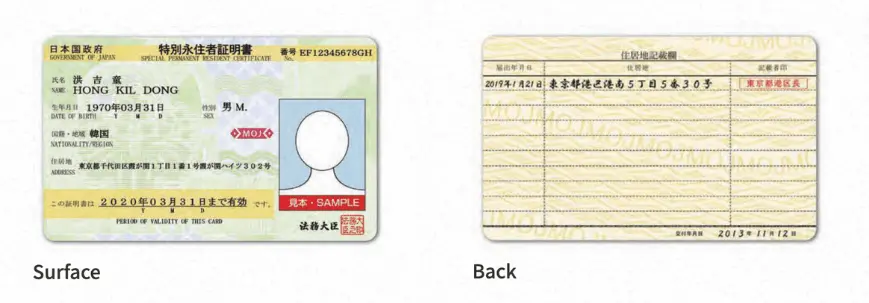
A permanent resident card example from MOJ
When the application has gone through all the checks, a postcard will be sent to your address, notifying you that your permanent residence card is ready to be picked up.
Go to the specified bureau counter and purchase a revenue stamp (10,000 yen as of April 2025; note that the Japanese government is expected to increase this fee significantly in FY2026 or FY2027, with the statutory cap raised to 300,000 yen under a March 2026 Cabinet decision).
Receive your Japan permanent residence card, and … might we suggest celebrations are in order?
Set a reminder to yourself to renew your permanent resident card every 7 years. If you plan to travel abroad, note that the Special Re-entry Permit (automatically granted at departure) is valid for 2 years.
If you need to stay abroad longer, you can apply for a standard re-entry permit valid for up to 5 years. If your re-entry permit expires while you are outside Japan, your permanent residency status is lost. Extended or frequent absences can also be questioned at renewal.
Important: PR revocation rules from April 2027. Under a revised Immigration Control and Refugee Recognition Act taking effect in April 2027, Japan's immigration authorities will be able to revoke permanent residency for intentional non-payment of taxes or social insurance premiums.
Unavoidable circumstances such as illness or unemployment are excluded, but the new law signals a stricter approach to PR compliance. Existing PR holders should ensure all tax, pension, and health insurance payments are current and on time.
👉 Note: If your application has been denied, you will receive a refusal notification in your mail. You can bring this refusal notification to the Immigration Bureau and ask for the refusal to be explained. However, this explanation will only happen once, so bring someone with you if you require Japanese assistance.
7 common missteps to avoid when applying for permanent residency status in Japan
The following missteps to avoid are summarized from accounts relayed on a broad range of immigration-related law sites and forums and reflect real-world experiences of the process.
Misstep 1: You didn't submit all your documents in Japanese.
All documentation must be submitted in Japanese. E.g., if you include a photocopy of an English-language degree, add an attached paper that provides the Japanese equivalent.
Misstep 2: You are late on a pension payment, or you aren't enrolled.
Many immigration services state that one of the primary causes for refusal is not enrolling in Japan's pension system or delayed pension payments.
As of 2026, the ISA enforces a zero-tolerance policy on late payments. Even a single late payment of tax, pension, or health insurance, even if later settled in full, can result in a denial. This applies to all social insurance obligations, and particular care is needed during job changes when switching between employer-managed insurance and the National Pension and National Health Insurance systems. (Source: Tokyo Immigration)
Misstep 3: You didn't promptly submit further requested documentation.
During the application process, an immigration official may reach out to you to request further proof or additional documentation. A prompt response is necessary. (Source: Tokyo Immigration)
Misstep 4: Your annual income did not match the requirements.
If you have many dependents, your taxable income will be lowered due to the deductions, which could become a reason for rejection. (Source: Continental Immigration)
Misstep 5: You left Japan for longer than 6 months during the PR application process.
If you left Japan after applying for a PR visa and stayed out of Japan for longer than 6 months, your application will be rejected due to the absence. (Source: June Advisors Group)
Misstep 6: You have repeated traffic violations.
Repeated traffic violations could be cause for refusal. The number should be less than 5 traffic fines in the last 5 years and less than 4 in the last 2 years. (Source: Continental Immigration)
Misstep 7: You did not have the correct number of points for the required number of years.
If you are applying based on the Point system, you must have the full amount of points at the time of application + 3 full years for the 70 points clause or 1 full year for the 80 points clause. (Source: Continental Immigration)
Frequently asked questions
How long does it take to get permanent residency in Japan?
The standard pathway requires 10 consecutive years of residence in Japan, with at least 5 of those years on a work visa or family-based status. However, spouses of Japanese nationals can apply after 3 years of marriage and 1 year of residence. The Highly Skilled Professional (HSP) points system reduces the requirement to 3 years (70 points) or 1 year (80 points). J-Skip visa holders can also apply after 1 year. Processing time after submission is 12 to 18 months in the Tokyo region as of 2026.
What are the income requirements for Japan PR?
Immigration authorities apply a practical benchmark of approximately 3 million yen in annual income for a single applicant, with an additional 700,000 to 800,000 yen per dependent. Income must be stable over the past 3 to 5 years. If you have many dependents, your taxable income may be reduced by deductions, which can become a reason for rejection. Self-employed applicants need to show consistent income through tax returns and business records.
Can I apply for permanent residency in Japan with a 3-year visa?
As of February 2026, Japan's ISA revised its PR guidelines to require that applicants hold a 5-year visa (the maximum period of stay for most categories). A transitional provision allows current 3-year visa holders to submit one PR application before March 31, 2027. After that date, only applicants holding a 5-year visa will be able to apply. The ISA determines whether to grant a 5-year visa based on residency stability, employment history, and tax compliance.
What documents do I need to apply for permanent residency in Japan?
The core documents include the permanent resident permit application form (eijuken shinseisho, 永住許可申請書), a 4x3 cm photograph, a reason letter written in Japanese, a certificate of residence (juminhyo, 住民票), proof of employment or tax returns, tax payment certificates for the past 3 to 5 years, pension and health insurance payment records, a photocopy of your passport and residence card, and a guarantor's letter with supporting documents. If applying under the HSP points system, you also need your points calculation sheet and evidence such as degree certificates and JLPT results.
Can Japan revoke permanent residency status?
Yes. Under a revised Immigration Control and Refugee Recognition Act taking effect in April 2027, Japan can revoke permanent residency for intentional non-payment of taxes or social insurance premiums. Unavoidable circumstances such as illness or job loss are excluded. Existing PR holders should ensure all obligations are current and paid on time. PR can also be lost if you leave Japan without a valid re-entry permit or if it expires while abroad.
How many points do I need for the Highly Skilled Professional fast track to PR?
You need 70 points maintained for 3 consecutive years to apply for PR after 3 years of residence, or 80 points maintained for 1 full year to apply after 1 year. Points are calculated based on academic qualifications, professional experience, annual salary, age, Japanese language ability (JLPT certification), and other factors. The Ministry of Justice provides an official Points Calculation Table and an English-language Excel form for self-assessment.
Is it possible to get permanent residency in Japan after only one year?
Yes, through two pathways. First, if you score 80 or more points on the HSP points system and maintain that score for 1 full year plus the year leading to your application. Second, if you hold a J-Skip visa, which requires an annual income of at least 20 million yen (or 40 million yen for business management roles) and either a master's degree or 10 or more years of professional experience. J-Skip was introduced in April 2023 and bypasses the standard points calculation.
What happens if my Japan PR application is denied?
If your application is denied, you will receive a refusal notification by postcard. You can bring this notification to the Immigration Bureau and ask for the specific reason for refusal. This explanation is provided only once, so bring a Japanese speaker if you need language assistance. Common reasons for denial include late pension or tax payments, insufficient income, gaps in residence, and incomplete documentation. You can reapply, but you should address the identified issues before submitting a new application.
In closing
We hope this guide helped you understand how to get permanent residency in Japan.
If you are thinking of living in Japan for an extended period of time, then having a permanent residency status can help to simplify many processes for you.
The paperwork required for permanent residency requires meticulous attention, so if you're looking for help with research or filling out applications, consider using MailMate's bilingual assistant service—which is exclusively available to MailMate users.
Spending too long figuring out your Japanese mail?
Virtual mail + translation services start at 3800 per month. 30-day money-back guarantee.